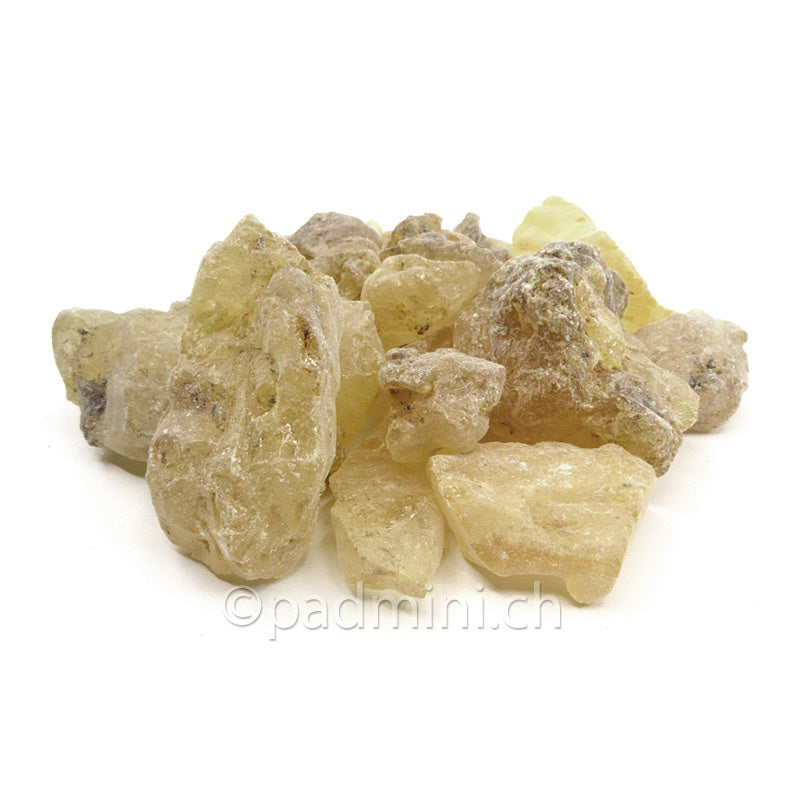
Manila Copal 50 g – Agathis dammara Incense Resin
Manila Copal 50 g – Agathis dammara Incense Resin
0344
Couldn't load pickup availability
Product description
Manila copal, also known as Copal Manila, is a natural incense resin from the tropical Asian conifer Agathis dammara. The species belongs to the Araucariaceae family. The pale, yellowish to amber-coloured resin develops a fresh, clear and pleasantly resinous fragrance when burned, with citrus, balsamic and slightly coniferous nuances.
Although this resin is referred to as “copal”, it is botanically very different from the well-known Mexican copal resins. Manila copal comes from an Asian conifer, whereas Mexican copals are obtained, among others, from species of the genus Bursera. The term copal therefore does not refer to a single plant species, but is used for various resins of different botanical origins.
Agathis dammara – a tropical conifer from Southeast Asia
Agathis dammara is an evergreen conifer belonging to the Araucariaceae family. Its natural range includes the Philippines, Sulawesi and the Moluccas, among other regions. However, the precise origin of the batch of resin offered here is not documented and is therefore not attributed to any particular region.
In older or regional sources, the botanical name Agathis philippinensis may also appear in connection with the resin source known in the Philippines as almaciga. This name is now treated as a synonym of Agathis dammara.
Manila copal is not Mexican copal
This distinction is particularly important when the resin is used as incense. The term “copal” encompasses various natural resins that are not necessarily related either botanically or geographically.
Manila copal comes from an Asian conifer. Traditional Mexican copals, by contrast, are obtained from Bursera bipinnata and other species of the genus Bursera in the Burseraceae family, among others.
Manila copal should therefore not be equated with Mexican copal resins. In particular, the well-known pre-Columbian and Mesoamerican incense traditions of the Maya, Nahua and other cultures relate to American copal resins and cannot simply be applied to Manila copal.
History and traditional use
Manila copal has its own history, independent of the American copal resins. For a long time, the resin was an important commodity and was used particularly as a raw material for high-quality lacquers, varnishes and other coatings.
In the Philippines, the resin source known as almaciga is also documented as an incense material used in religious ceremonies. Other traditional practical uses of the resin include lighting fires, making torches and sealing boats.
This Asian history clearly distinguishes Manila copal from the ceremonial copal resins of Mesoamerica and makes it a distinct type of incense resin with its own botanical and cultural origins.
Fragrance profile – fresh, resinous and citrusy
When burned, Manila copal develops a fresh, resinous and distinctly aromatic fragrance. It is characterised by bright citrus and balsamic nuances, together with a facet slightly reminiscent of coniferous woods.
Its fresh resinous note can be somewhat reminiscent of frankincense in olfactory terms. However, Manila copal is not frankincense and does not come from a Boswellia tree. The fragrance character and intensity may vary somewhat depending on the quality of the resin and the intensity of the heat.
Burning Manila copal as incense
The resin can be burned on incense charcoal or with a gentler heat source. Only a small amount is needed on fully glowing charcoal to produce a strong fragrance. Those wishing to appreciate the fresher citrus and balsamic nuances in greater detail can slowly warm the resin on a suitable incense mesh or incense burner.
Manila copal can be used on its own or combined with other natural resins, woods and aromatic plants. Thanks to its fresh and clear fragrance character, it is particularly well suited to incense blends where a bright, resinous and slightly citrusy note is desired.
Symbolism in contemporary incense practices
In various contemporary incense and spiritual practices, Manila copal is associated with symbolic purification, protection and the blessing of spaces. It is also used as an incense accompaniment for meditation and prayer.
Some modern esoteric traditions additionally associate copal with intuition, imagination and creativity, or attribute to it symbolic protection from influences perceived as negative. These are spiritual beliefs and not proven effects.
These modern associations should also not be equated with the documented religious uses of the resin in the Philippines. They belong to different contemporary incense practices and cannot simply be traced back to a historical Philippine tradition.
Product characteristics
- Product: Manila Copal / Copal Manila
- Botanical name: Agathis dammara
- Plant family: Araucariaceae
- Plant type: tropical Asian conifer
- Plant part used: natural tree resin
- Fragrance character: resinous, fresh, citrusy, balsamic and slightly coniferous
- Net contents: 50 g
- Use: for burning on charcoal or with a suitable gentle heat source
For incense burning only. Place the incense vessel on a stable, heat-resistant surface and never leave it unattended. Keep children and pets away, do not inhale the smoke directly and ventilate the room thoroughly after burning the incense.