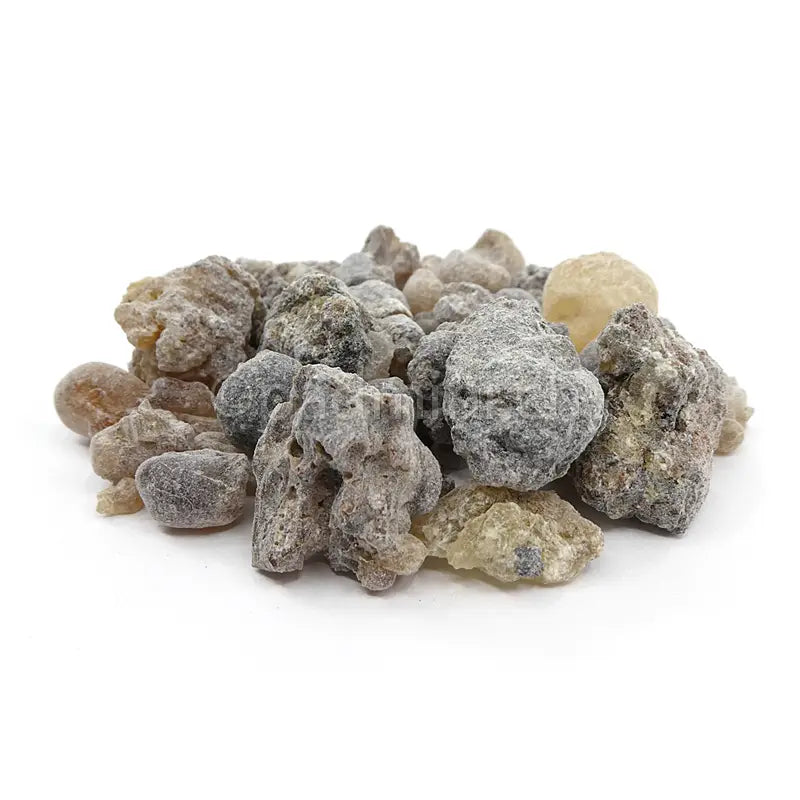
Mirafur Frankincense from Ethiopia 50 g – Boswellia rivae
Mirafur Frankincense from Ethiopia 50 g – Boswellia rivae
1697
Couldn't load pickup availability
Product description
Mirafur Frankincense from Ethiopia is a natural olibanum resin from the Ogaden region in the east of the country, near the Somali border. The specialist importer Mothers Goods botanically identifies this resin grade as Boswellia rivae. The irregular, carefully sorted resin pieces have predominantly greyish-brown surfaces, darker in places, and release an intense, complex fragrance with earthy, balsamic and pleasantly sweet nuances when burned as incense.
Mirafur therefore differs considerably from the pale frankincense varieties with predominantly lemony fragrances. Its particular appeal lies in the combination of deep, dark earthy notes, spicy intensity and restrained sweetness.
Mirafur – frankincense from the Ogaden region
The Ogaden region in eastern Ethiopia is one of the arid landscapes of the Horn of Africa where various frankincense trees of the genus Boswellia grow. Their aromatic resins have long been collected and traded as incense materials.
According to the importer, the Mirafur offered here comes directly from this region. The resin pieces vary in size and display a natural diversity of shapes and colours. Alongside greyish-brown and darker areas, lighter yellowish to amber-coloured sections are also visible. Many pieces have a matt, slightly powdery surface.
Boswellia rivae, neglecta and ogadensis – botanical classification
The name Mirafur is a local or commercial designation rather than a scientific species name. The importer identifies the resin offered here as Boswellia rivae, a frankincense tree species found in Ethiopia, Somalia and northeastern Kenya.
The botanical names Boswellia neglecta and Boswellia ogadensis are also encountered in connection with frankincense from this region. However, botanical literature recognises these as distinct species, and they are not generally accepted synonyms of Boswellia rivae.
This distinction is important because regional trade names cannot always be assigned unequivocally to a single botanical species. For this Mirafur grade, Boswellia rivae remains the identification provided by the importer. No independent botanical identification of the resin batch offered here is available.
Fragrance profile – earthy, balsamic and pleasantly spicy
When heated, Mirafur releases an intense, deep and complex frankincense fragrance. Distinct earthy notes form its characteristic foundation, accompanied by a warm, balsamic sweetness.
A slightly piquant, spicy facet adds a particular liveliness to the fragrance. Overall, Mirafur has a darker, richer character rather than a bright, citrus-dominated aroma. Its sweetness remains subtle, blending with the stronger earthy fragrance notes.
Its fragrance is somewhat reminiscent of Kenyan Dakkara frankincense from Boswellia neglecta, which is also known for its distinctly earthy character. This similarity concerns the aroma and does not imply that the two resins are botanically identical.
Frankincense in traditional incense culture
The aromatic resins of the genus Boswellia have been valued as incense materials in the Horn of Africa and neighbouring regions for centuries. Various frankincense grades reached the Middle East and the Mediterranean through historical trade routes.
In different religious and cultural traditions, frankincense accompanies prayers, ceremonies and personal incense rituals. Its rising smoke is symbolically associated with purification, contemplation and spiritual reflection. These associations belong to frankincense traditions in general and should not be understood as proven effects or rituals specific to Mirafur.
For enthusiasts of natural incense resins, Mirafur offers an interesting aromatic alternative to fresher frankincense varieties. Its earthy, balsamic character makes it a distinctive fragrance discovery.
How to burn Mirafur frankincense
To appreciate the different fragrance nuances of this resin, slow, controlled heating is recommended initially.
- On an incense burner: Place a few small resin pieces on a suitable incense plate or incense mesh and heat them at a moderate temperature. This allows the earthy, balsamic and sweetly spicy fragrance facets to emerge gradually.
- On incense charcoal: Place a small amount of resin on fully glowing incense charcoal. Direct heat produces more substantial smoke, so using the resin sparingly is recommended.
- In incense blends: Mirafur can be combined with other natural incense materials. Particularly when blended with fresher frankincense varieties, interesting contrasts can emerge between earthy depth and brighter resinous notes.
The resin pieces vary in size and can be carefully broken into smaller fragments if required. To discover its distinctive fragrance character, it is advisable to burn Mirafur on its own initially.
Product characteristics
- Product: Mirafur Frankincense
- Botanical identification: Boswellia rivae, according to the importer
- Plant family: Burseraceae (frankincense and myrrh family)
- Country of origin: Ethiopia
- Region of origin: Ogaden
- Material: natural frankincense resin
- Form: irregular resin pieces of varying sizes
- Colour: predominantly greyish-brown to dark brown, sometimes with yellowish or amber-coloured areas and a pale, powdery surface
- Fragrance character: intense, earthy, balsamic, sweet and slightly piquant and spicy
- Net contents: 50 g
- Use: for burning on charcoal or on a suitable incense burner
For incense burning only. Place the incense vessel on a stable, heat-resistant surface and never leave it unattended. Use the resin sparingly, avoid directly inhaling the smoke and ventilate the room thoroughly after burning the incense. Keep children and pets away from the heat source.