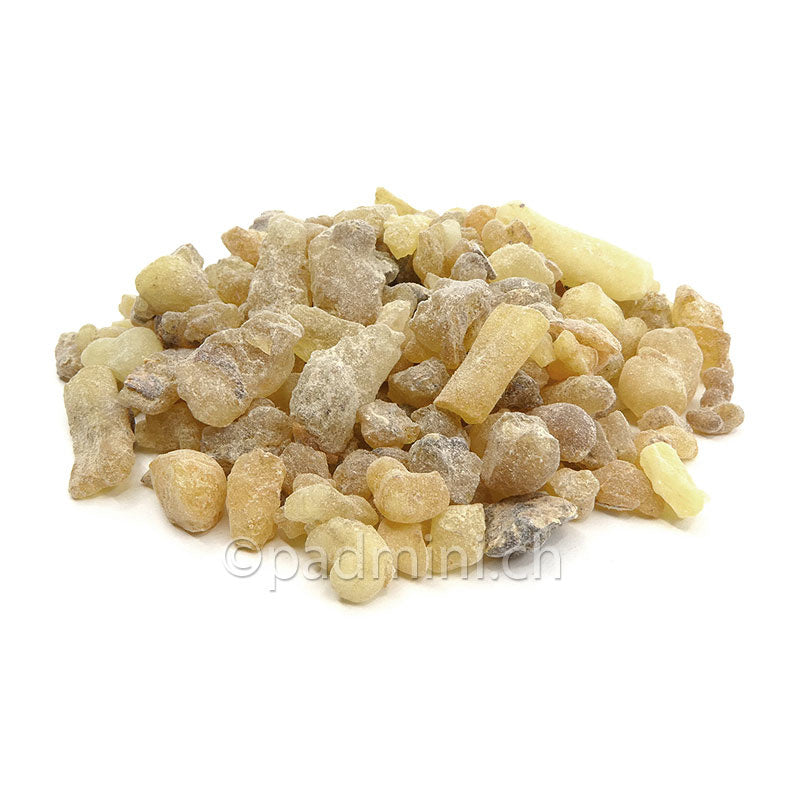
Moxor Frankincense from Somalia 50 g – Small Resin Pieces
Moxor Frankincense from Somalia 50 g – Small Resin Pieces
1691
Couldn't load pickup availability
Product description
Moxor Frankincense from Somalia, also known as Mohor, is a natural olibanum resin from the Bari region in northern Puntland. The resin comes from the frankincense type Boswellia carterii and is distinguished by its fresh, distinctly lemony fragrance with fruity, balsamic and slightly earthy nuances. Its particular characteristic is its smaller grain size: Moxor consists of the smaller resin pieces of the same frankincense grade offered in a larger size under the name Beeyo.
The pale yellow, cream to amber-coloured grains and fragments vary in shape and size. Some pieces are rounded, while others are elongated or irregularly broken. Their surfaces are sometimes matt and powdery, while other areas are slightly translucent.
Moxor and Beeyo – the same frankincense, sorted by size
For this importer, the distinction between Moxor and Beeyo primarily concerns the size of the resin pieces. The smaller fragments are separated from the larger pieces by sieving. According to the importer, this sorting takes place in his own warehouse.
The larger resin pieces are sold as Beeyo, while the smaller grains are marketed under the names Moxor or Mohor. Both come from the same frankincense grade and, according to the supplier, share the same characteristic fragrance profile.
The importer describes Mohor as a second commercial grade. In this case, the classification refers to grain size and does not mean that the resin has a different botanical origin or is inherently of lower aromatic quality. Nor is this a universally recognised grading system used by all frankincense traders.
The smaller resin pieces are particularly convenient when only small quantities are needed for incense burning. They can be measured out individually without first having to break larger resin tears into smaller pieces.
Origin – frankincense from Puntland, Somalia
Moxor comes from the Bari region in northern Puntland, an area of northeastern Somalia on the Gulf of Aden. This region is one of the traditional sources of Somali frankincense.
The frankincense trees of the genus Boswellia found there produce aromatic resins that have been collected for centuries and traded through regional and international trade routes. According to the specialist importer, this frankincense is sourced directly from Somalia.
The botanical trade designation is Boswellia carterii, also written Boswellia carteri. In modern botanical taxonomy, Boswellia carteri is among the names treated as a synonym of Boswellia sacra. However, the name Boswellia carterii remains widely used in the trade, particularly for Somali frankincense.
Fragrance profile – lemony, fruity and balsamic
When heated, Moxor releases an intense, fresh citrus fragrance, accompanied by lively, slightly fruity notes. Its lemony freshness is particularly prominent and combines with the characteristic resinous aroma of olibanum.
In the background, warmer balsamic nuances emerge, together with delicate hints of pine and a slightly amber-like impression. Subtle earthy notes give the fragrance additional depth without overshadowing its predominantly fresh character.
The terms pine and amber describe natural fragrance impressions only, not added ingredients.
As Moxor and Beeyo come from the same resin selection, their fragrance characteristics are essentially identical. The smaller grain size alone does not imply greater fragrance intensity or a longer or shorter incense-burning duration.
Frankincense in traditional incense culture
Somali frankincense is one of the traditional aromatic resins of the Horn of Africa. Through historical trade connections, olibanum reached various regions of the Arabian Peninsula, the Mediterranean and beyond.
In numerous religious and cultural traditions, frankincense is used during prayers, ceremonies and personal incense rituals. In different traditions, its rising smoke symbolises purification, reflection and spiritual contemplation.
Today, olibanum is also burned during quiet moments, meditation or simply for its natural fragrance. These symbolic associations belong to the broader traditions surrounding frankincense and do not represent scientifically proven effects.
How to burn Moxor frankincense
The small resin pieces are easy to measure out and are suitable both for gentle heating on an incense burner and for traditional incense burning on charcoal.
- On an incense burner: Place a few small resin grains on a suitable incense plate or incense mesh and heat them slowly at a moderate temperature. This allows the fresh citrus notes and balsamic fragrance nuances to be appreciated in greater detail.
- On incense charcoal: Allow an incense charcoal tablet to become fully glowing until a grey layer of ash has formed. Then place a few grains on top. At high temperatures, substantial smoke can develop quickly.
- In incense blends: Moxor can be combined with other natural resins. Its fresh, lemony notes can, for example, provide an appealing contrast to the warm, earthy and balsamic fragrance of myrrh.
For the first incense-burning session, it is advisable to use just a few grains and add more as required. This allows the fragrance to develop gradually and the desired intensity to be adjusted according to personal preference.
Product characteristics
- Product: Moxor Frankincense, also known as Mohor
- Botanical trade designation: Boswellia carterii / Boswellia carteri
- Plant family: Burseraceae (frankincense and myrrh family)
- Country of origin: Somalia
- Region of origin: Bari, Puntland
- Material: natural frankincense resin
- Grading: smaller resin pieces and grains, commercially designated as Mohor/Moxor
- Colour: cream, pale yellow, beige to amber, with occasional greyish-brown pieces
- Fragrance character: fresh, lemony, fruity, resinous and balsamic, with pine-like, amber-like and slightly earthy nuances
- Net contents: 50 g
- Use: for burning on charcoal or on a suitable incense burner
For incense burning only. Place the incense vessel on a stable, heat-resistant surface and never leave it unattended. Use the resin sparingly, avoid directly inhaling the smoke and ventilate the room thoroughly after burning the incense. Keep children and pets away from the heat source.