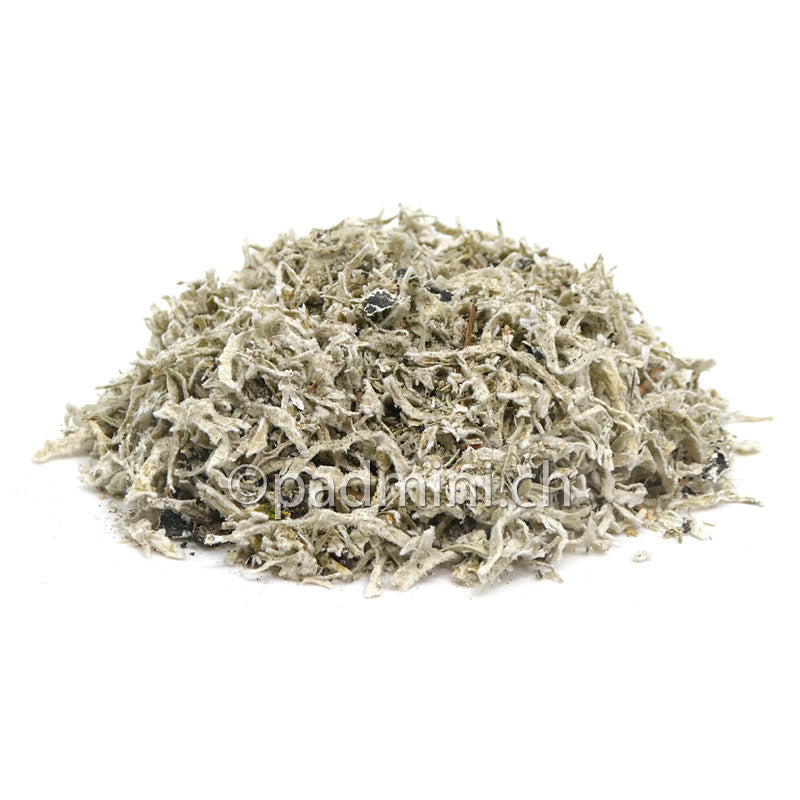
Oakmoss 50 g – Evernia prunastri for Incense Burning
Oakmoss 50 g – Evernia prunastri for Incense Burning
1427
Couldn't load pickup availability
Product description
Oakmoss (Evernia prunastri) is an aromatic lichen with a deep, unmistakably forest-like character. When burned as incense, dried oakmoss releases an earthy fragrance reminiscent of forest floors and undergrowth, accompanied by spicy and slightly leathery nuances. In contemporary incense practices, it is particularly associated with grounding, stability, protection and symbolic purification.
Despite its name, oakmoss is botanically not a moss but a lichen. Lichens arise from a close symbiotic relationship between a fungus and a photosynthetically active partner. Evernia prunastri grows on the bark and branches of various trees and is by no means restricted to oaks.
From the forest to the world of fragrance
Oakmoss holds a special place in the history of perfumery. Extracts obtained from the lichen are valued for their deep, earthy and forest-like character and played an important role in the development of classic Chypre and Fougère fragrances. This fragrance tradition became particularly well known through François Coty's perfume Chypre, launched in 1917, which gave the modern Chypre fragrance family its name.
However, the dried oakmoss offered here should not be equated with an oakmoss extract or absolute used in perfumery. Burning the natural lichen as incense produces its own distinctive fragrance character.
A fragrance reminiscent of damp undergrowth
When burned as incense, oakmoss develops a deep, aromatic and earthy forest fragrance with spicy and slightly leathery nuances. Its most distinctive association is with undergrowth and forest floors – natural, dark and vegetal, without pronounced floral or sweet notes.
The dried oakmoss can be used in small quantities on its own or together with other plants and natural resins on suitable incense charcoal. In blends, it is particularly suitable for adding a distinctly earthy and forest-like base character. A heat-resistant incense vessel and good ventilation are recommended; the smoke should not be inhaled directly.
Grounding, protection and symbolic purification
In contemporary incense practices, oakmoss is particularly associated with grounding, stability and inner strength. Its forest-like character accompanies incense rituals intended to symbolically convey a sense of security, protect the home or support a moment of contemplation and retreat.
Other contemporary associations include the symbolic purification of spaces and protection against influences perceived as negative. Oakmoss is also used in incense rituals accompanying letting go, change and transitions, as well as in some contemporary rituals during the Rauhnächte, the traditional Twelve Nights.
Some esoteric interpretations extend the traditional symbolism of the oak tree as a symbol of strength and protection to oakmoss. Others see the symbiotic relationship that forms a lichen as a symbol of cooperation, balance and harmonious relationships. These interpretations belong to contemporary spiritual beliefs and do not represent proven properties of the lichen.
No historically documented tradition as a “Celtic incense plant”
Oakmoss is occasionally associated with Druids, Celts or ancient Germanic incense traditions. However, there is insufficient reliable evidence of such a specific historical use as a sacred incense material. Its contemporary associations with protection, purification and grounding should therefore not be presented as a documented continuation of an ancient European incense ritual.
- Botanical name: Evernia prunastri (L.) Ach.
- Family: Parmeliaceae
- Plant material: dried lichen thallus
- Origin: North Macedonia
- Fragrance when burned: forest-like, earthy, aromatic, spicy and slightly leathery
- Use: for incense burning, on its own or in incense blends
- Net weight: 50 g