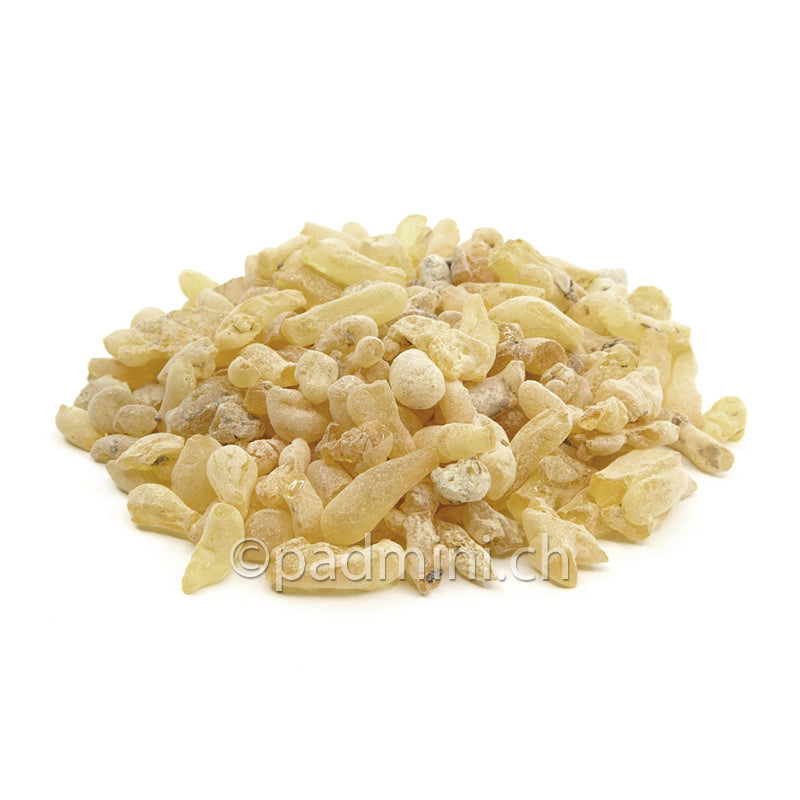
Sandarac from Morocco 40 g – Natural Incense Resin
Sandarac from Morocco 40 g – Natural Incense Resin
0348
Couldn't load pickup availability
Product description
Sandarac from Morocco is a natural incense resin from the North African sandarac tree (Tetraclinis articulata), also known as Barbary thuja or Atlas thuja. When gently heated, the small, pale yellow to golden resin tears release a delicate, fresh and slightly balsamic fragrance with woody and subtle citrus-like nuances.
This traditional resin from North Africa is distinguished not only by its subtle fragrance but also by its remarkable history as an incense material and a valuable raw material in the production of traditional craft lacquers and varnishes.
Sandarac – the resin of the North African Barbary thuja
The sandarac tree (Tetraclinis articulata) belongs to the cypress family (Cupressaceae). It grows mainly in the dry, warm regions of North Africa, particularly in Morocco, where it is also known as Arar. Despite its common name, Barbary thuja is botanically distinct from the true arborvitae trees of the genus Thuja.
The aromatic resin exudes from the trunk and branches, either naturally or following damage or incisions to the bark. On exposure to air, it hardens into solid, brittle and sometimes translucent resin tears. Their colour ranges from pale yellow through golden yellow to a slightly amber hue.
Our sandarac comes from Morocco and is offered in the form of small, irregular resin grains and tears.
A traditional resin for incense burning and craftsmanship
Sandarac has a long history in the Mediterranean region and North Africa. The resin was traditionally used for incense burning, sometimes in connection with ritual practices and concepts of symbolic purification. The aromatic smoke played a central role in these practices, although this does not imply any actual purifying effect.
However, sandarac also acquired particular importance beyond incense traditions. As early as the Middle Ages, and especially during the Renaissance, the resin became a valued raw material for the production of varnishes and transparent lacquers.
In European painting and craftsmanship, sandarac was an ingredient in various historical varnish recipes. In Italy in particular, such resin varnishes were used to give surfaces a clear, glossy and durable coating. The hardness and transparency of the dried resin made it especially suitable for these applications.
Sandarac was also used in furniture finishing, musical instrument making and the treatment of decorative objects. This history of craftsmanship distinguishes the resin from many other incense resins, which are primarily known for their fragrance. However, the product offered here is intended for incense burning and is not designated as a ready-to-use or tested raw material for varnish production.
Fragrance profile – fresh, resinous and delicately balsamic
When gently heated, sandarac releases a fresh, resinous and slightly balsamic fragrance. Subtle woody notes are reminiscent of coniferous trees, accompanied by a delicate, slightly citrus-like nuance.
Its fragrance is comparatively mild and less intense than that of many other incense resins. This subtle aromatic character makes sandarac particularly interesting for light incense burning and for blends in which a fresh, woody resinous note is desired.
When exposed to excessive heat, the fragrance can quickly become smokier and more bitter. Slow, moderate heating allows its finer aromatic nuances to emerge more clearly.
How to burn sandarac
Sandarac can be used on its own or combined with other natural incense materials. Its small, brittle resin tears are easy to measure out and can be broken into smaller pieces if required.
- On incense charcoal: Place just a few resin grains on fully glowing incense charcoal. Begin with a small amount, as the resin can produce smoke quickly when exposed to direct heat.
- On an incense burner: Carefully warm the resin at a moderate temperature. This method is particularly suitable for appreciating its fresh, balsamic and woody fragrance nuances.
- In incense blends: Sandarac can be combined with frankincense, other mild resins and aromatic woods. Its subtle freshness can complement warmer and heavier fragrance notes.
Sandarac is particularly interesting for those who wish to discover less common incense materials with their own botanical and cultural history, alongside familiar resins such as frankincense, myrrh and benzoin.
Product characteristics
- Product: Sandarac – natural incense resin
- Botanical name: Tetraclinis articulata
- Plant family: Cupressaceae (cypress family)
- Origin: Morocco
- Material: natural tree resin
- Form: small, irregular resin tears and grains
- Appearance: pale yellow to golden yellow, sometimes slightly amber-coloured and translucent
- Fragrance character: fresh, resinous, slightly balsamic, woody and subtly citrus-like
- Net contents: 40 g
- Use: for burning on charcoal or on a suitable incense burner
For incense burning only. Place the incense vessel on a stable, heat-resistant surface and never leave it unattended. Use the resin sparingly, avoid directly inhaling the smoke and ventilate the room thoroughly after burning the incense. Keep children and pets away from the heat source.