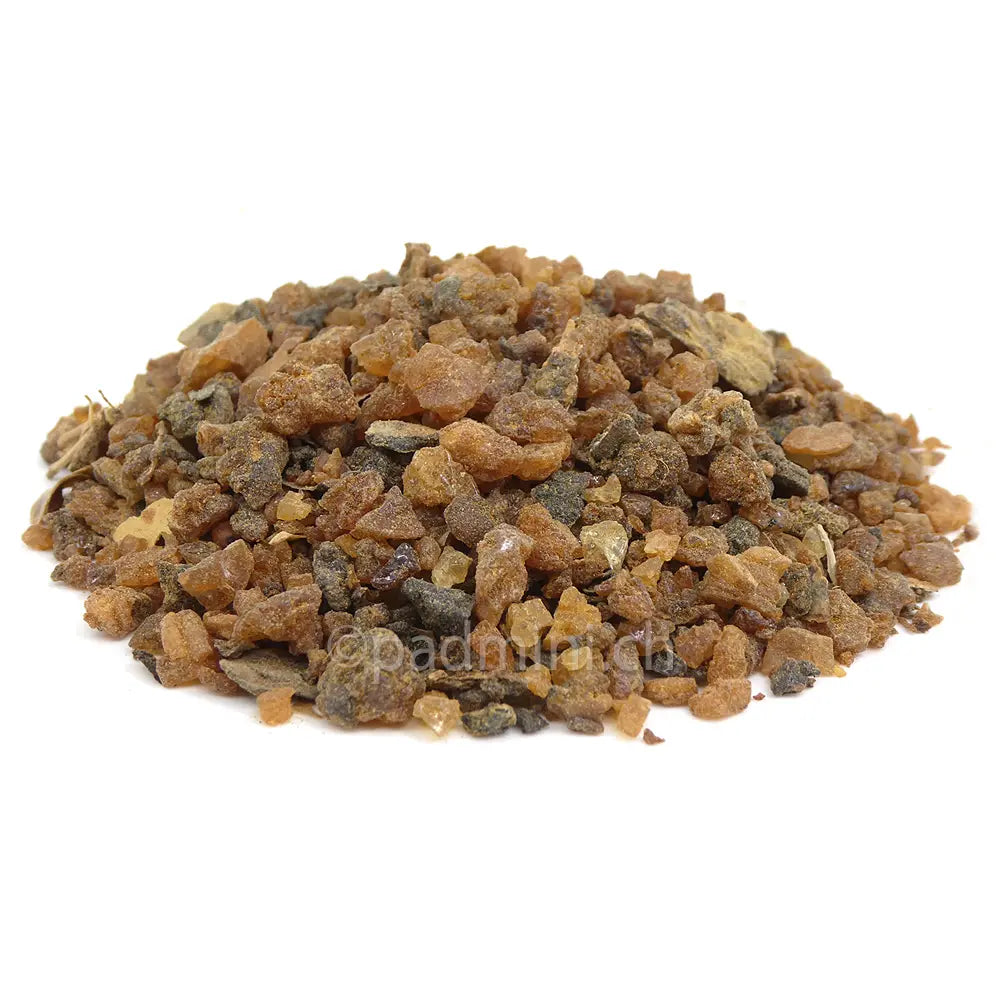
Suhul Myrrh from Somalia 40 g – Small Resin Pieces
Suhul Myrrh from Somalia 40 g – Small Resin Pieces
1933
Couldn't load pickup availability
Product description
Suhul Myrrh from Somalia is a natural incense resin from the myrrh tree Commiphora myrrha. This special resin quality forms when resin exudes naturally through the tree's bark without deliberate incisions being made. The variety offered here consists of small, irregular resin pieces in various shades of amber, golden yellow and brown.
This is the same Suhul myrrh as our first-grade selection of larger resin pieces. The only difference is the size of the fragments: the smaller pieces have the same aromatic properties but are particularly easy to measure out and use in your own incense blends.
Suhul – a special quality of myrrh from Somalia
The myrrh tree Commiphora myrrha belongs to the Burseraceae family and grows in the dry regions of the Horn of Africa and the Arabian Peninsula. After emerging through the bark, its aromatic resin hardens into irregular, sometimes translucent resin tears.
Suhul myrrh is distinguished by its traditional method of collection. The resin exudes spontaneously from the tree and is gathered without making deliberate incisions in the bark to extract it. This natural resin secretion is relatively limited, making Suhul a highly valued quality.
While the selection designated as first grade consists primarily of larger pieces, this variety contains smaller fragments of the same resin quality. It should therefore not be regarded as inferior myrrh. Instead, the different piece sizes offer various practical possibilities for incense burning.
Fragrance profile – balsamic, warm and slightly spicy
When gently heated, Suhul myrrh releases a deep, warm and balsamic fragrance. Woody and earthy nuances mingle with a slight spiciness and a subtle, gently sweet note.
Compared with some ordinary qualities of myrrh, Suhul is often described as rounder, softer and less bitter. Nevertheless, its fragrance retains the characteristic earthy and resinous undertone that distinguishes myrrh from many other incense resins.
As the small fragments respond to heat more quickly than larger resin pieces, it is advisable to use them sparingly. At a moderate temperature, the finer balsamic and woody fragrance nuances can be appreciated particularly well.
Myrrh and frankincense – two resins with a long history
Alongside frankincense, myrrh is one of the most important aromatic resins of antiquity. These precious natural substances travelled along ancient trade routes from the Horn of Africa and the Arabian Peninsula to the Mediterranean region. They were valued for fragrant preparations, incense burning and religious ceremonies.
Myrrh was already known in Ancient Egypt and the cultures of the Middle East. It is also mentioned in biblical traditions and continues to hold a special place in various religious and cultural traditions today.
In traditional incense practices, myrrh is often associated with prayer, reflection and symbolic purification. In some traditions, it also represents protection and inner composure. These meanings should be understood as cultural and spiritual beliefs rather than scientifically proven effects.
Small resin pieces – convenient for measuring out
The smaller Suhul fragments are particularly suitable for those who prefer to prepare their incense in small quantities. The grains and pieces of varying sizes can be used directly, without first having to break larger resin tears into smaller fragments.
On fully glowing incense charcoal, only a small amount is needed to release the characteristic fragrance of myrrh. Additional fragments can be added as required, allowing the intensity of the incense burning to be adjusted gradually.
For a gentler release of fragrance, a suitable incense burner with adjustable heat is recommended. At low to moderate temperatures, the warm, balsamic and woody nuances become more pronounced, whereas excessive heat can make the fragrance more bitter and smoky.
The small pieces are also particularly convenient for creating your own incense blends. When combined with frankincense, myrrh complements its often fresher resinous notes with a warm, earthy and balsamic component. It also combines well with aromatic woods and other natural incense materials.
Product characteristics
- Product: Suhul Myrrh – Small Resin Pieces
- Botanical name: Commiphora myrrha
- Plant family: Burseraceae
- Origin: Somalia
- Material: natural tree resin
- Harvesting: traditionally collected, spontaneously exuded resin tears without deliberate incisions
- Quality: Suhul, the same resin quality as the large first-grade pieces
- Form: small, irregular resin pieces and fragments
- Appearance: various shades of amber, golden yellow and brown, sometimes with darker areas
- Fragrance character: warm, balsamic, resinous, woody, earthy and slightly spicy
- Net contents: 40 g
- Use: for burning on charcoal, on a suitable incense burner and for creating your own incense blends
For incense burning only. Place the incense vessel on a stable, heat-resistant surface and never leave it unattended. Use the resin sparingly, avoid directly inhaling the smoke and ventilate the room thoroughly after burning the incense. Keep children and pets away from the heat source.