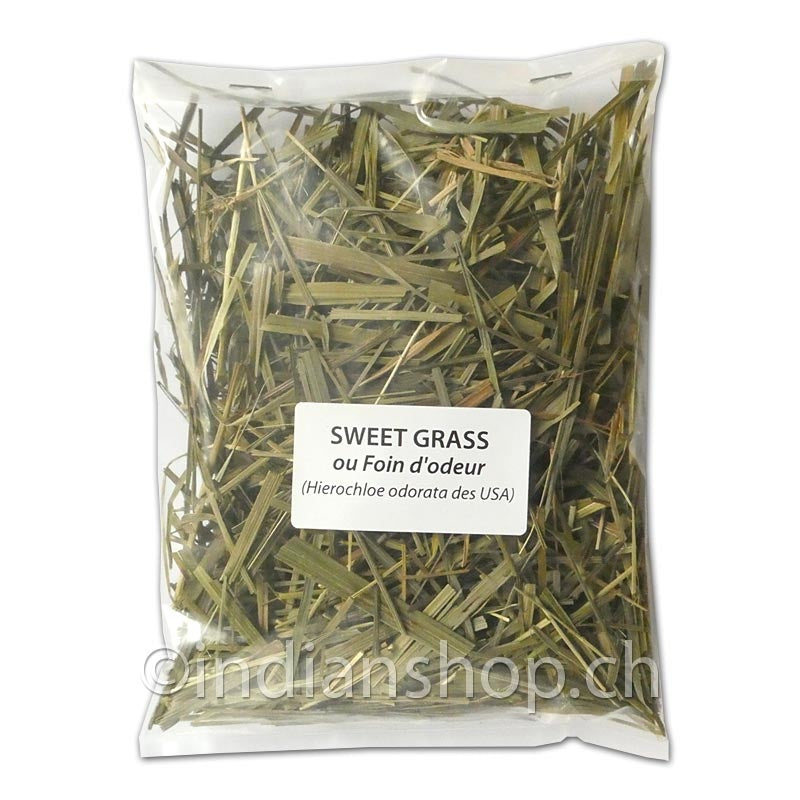
Sweetgrass – Fragrant Holy Grass 20 g
Sweetgrass – Fragrant Holy Grass 20 g
1397
Couldn't load pickup availability
Product description
Sweetgrass, also known as Fragrant Holy Grass (Hierochloe odorata), is an aromatic grass that holds particular significance in the spiritual traditions of various Indigenous communities in North America. Its characteristic sweet fragrance is reminiscent of freshly dried hay and vanilla. This Sweetgrass from Poland is offered as 20 g of loose, whole, dried grass blades. It is not braided and is suitable for burning as incense on charcoal, on a suitable incense mesh screen or as an ingredient in homemade incense blends.
Spiritual Significance – Cleansing, Protection and Positive Energies
Sweetgrass is among the plants associated with spiritual cleansing, protection, peace and goodwill in various North American incense burning traditions. Its fragrant smoke accompanies prayers, ceremonies and the symbolic cleansing of people and places. The specific meanings and uses vary according to the community and its traditions.
One particularly significant belief is that burning Sweetgrass as incense serves not only to release unwanted influences but also to welcome benevolent forces, good spirits and positive energies. In this sense, Sweetgrass is associated with creating an inviting, peaceful and harmonious atmosphere.
While some incense plants are primarily associated with dispelling negative energies, Sweetgrass is often used with the intention of filling a symbolically cleansed space with positive thoughts, gratitude and good wishes. These beliefs form part of the plant's spiritual and cultural significance and should not be understood as guaranteed effects of its smoke.
Sweetgrass can also be used on its own for symbolic cleansing. Its significance is by no means limited to a complementary role following the use of other incense plants.
Sweetgrass in the Traditions of Indigenous North American Communities
Fragrant Holy Grass has a long history of cultural significance in the ceremonies of various Indigenous peoples of North America. Traditional uses are documented among the Lakota, Dakota, Blackfeet, Cheyenne, Ojibwe and Cree, among others. It is important to recognise that each community has its own teachings, ceremonies and beliefs associated with the plant.
In the teachings shared by the Cree Board of Health and Social Services of James Bay in Eeyou Istchee, Sweetgrass is regarded as a sacred plant associated with peace, prayer and connection with the Creator. Its smoke may accompany prayers and express spiritual connection.
In certain Anishinaabe teachings, Sweetgrass is particularly associated with kindness, goodness and goodwill. In these traditions, it is one of the four sacred plants, or traditional "Medicines", alongside tobacco, sage and cedar. This classification belongs to particular cultural traditions and does not apply universally to all Indigenous communities in North America.
In various traditions, Sweetgrass is often woven into long braids. Some teachings associate this braided form with love, kindness and gentleness, or with the unity of body, mind and the spiritual dimension. Such interpretations vary between cultures and are not universal.
The Sweetgrass offered here consists of loose, unbraided grass blades. It therefore does not have the distinctive physical form of a traditional braided Sweetgrass bundle. The cultural background is described to provide context for the plant, without presenting this product as an Indigenous ceremonial preparation.
Sweetgrass and White Sage – Two Different Ritual Intentions
In some contemporary incense burning practices, White Sage and Sweetgrass are used in succession. White Sage first accompanies the symbolic cleansing of a place and the release of unwanted influences. Sweetgrass is then burned to express the intention of welcoming goodwill, harmony and positive energies.
This sequence illustrates two complementary ritual intentions: consciously letting go of burdensome influences and subsequently welcoming what is good. However, it is not a universally prescribed practice in North American Indigenous traditions.
Sweetgrass can equally be burned independently of other plants, for example during prayer, a moment of gratitude, personal reflection or a ritual marking the beginning of a new stage in life.
Fragrance Profile – Sweet Hay, Vanilla and Warm Herbal Notes
The fragrance of Sweetgrass is one of its most distinctive characteristics. Even when dried, the grass blades release a soft, sweet fragrance reminiscent of fresh hay, vanilla and a hint of honey.
A significant part of this characteristic aroma comes from coumarin, a compound naturally present in the plant. This aromatic substance contributes to the typical scent of dried grasses and explains names such as Vanilla Grass and Fragrant Holy Grass.
When gently heated or allowed to smoulder, the sweet hay and vanilla notes develop alongside warmer, botanical and slightly smoky nuances. On very hot incense charcoal, the fragrance may become stronger and smokier than the scent of the dried blades themselves.
Unlike the strong, camphor-like fragrance of White Sage, Sweetgrass has a distinctly softer, sweeter and more hay-like aromatic character.
Fragrant Holy Grass – Botany and Origin
Sweetgrass belongs to the grass family (Poaceae). The plant is widely known by the botanical name Hierochloe odorata. Under more recent botanical classification, it is also recognised by the accepted name Anthoxanthum nitens.
This aromatic grass is not native exclusively to North America but also occurs in other regions of the Northern Hemisphere. Besides Sweetgrass and Fragrant Holy Grass, common names include Sweet Grass, Vanilla Grass and Bison Grass.
The product offered here originates from Poland. It consists of whole, dried grass blades packaged loose rather than woven into braids. The North American traditions described above explain the cultural significance of the plant species, not the origin or preparation method of this particular product.
How to Burn Loose Sweetgrass as Incense
As this Sweetgrass consists of loose, whole grass blades, it can easily be used in individual portions. Take a small quantity and, if necessary, cut the blades into shorter pieces to make them easier to measure out.
On incense charcoal: Place a small amount of Sweetgrass onto glowing incense charcoal in a suitable fireproof vessel. Start with just a few blades and add more plant material if required. Direct heat produces a more intense, smoky fragrance.
On an incense mesh screen: Spread a small quantity over a suitable incense mesh screen positioned above a heat source. Adjusting the distance from the heat allows the grass to be warmed more gently. An appropriate incense dish or mesh insert can prevent small pieces of plant material from falling through the screen.
In incense blends: The dried blades can be used on their own or chopped and combined with other aromatic plants, woods and resins. Their sweet, hay-like character can provide an interesting contrast to spicy, woody or resinous incense fragrances.
The loose grass blades are not intended to function as an incense bundle that burns independently and evenly. For this product format, a suitable incense burning surface with controlled heat is therefore recommended.
Safety precautions: Use only suitable, heat-resistant incense vessels and ensure adequate ventilation. Avoid inhaling the smoke directly. Never leave glowing charcoal or other heat sources unattended, and keep them away from children, pets and flammable materials. After burning incense, check that all glowing embers have been completely extinguished.
Product Details
- Common names: Sweetgrass, Fragrant Holy Grass, Sweet Grass, Vanilla Grass
- Botanical name: Hierochloe odorata (currently accepted name: Anthoxanthum nitens)
- Botanical family: Grass family (Poaceae)
- Origin: Poland
- Material: Whole, dried grass blades
- Form: Loose, unbraided
- Contents: 20 g
- Fragrance: Sweet, hay-like, vanilla-like, slightly honey-like and warmly herbaceous
- Use: For burning as incense on charcoal or a suitable incense mesh screen, and for making homemade incense blends
As a natural product, Sweetgrass may vary in colour and in the length and width of individual grass blades.